BA vs PM: Business Analyst vs Project Manager – Roles, Skills, Differences
Understand the real difference between Business Analyst and Project Manager in IT and Agile teams. BA vs PM roles, deliverables, and responsibilities explained.
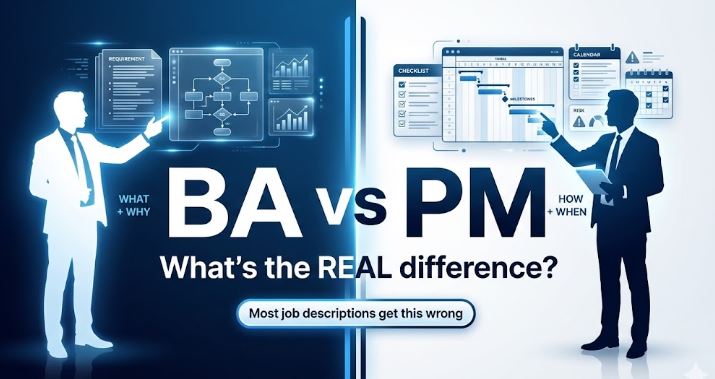
If you’ve ever heard someone say, “Business Analyst and Project Manager are basically the same,” you’re not alone. In IT and US staffing, this confusion is everywhere—especially in job descriptions where companies combine responsibilities and give one title. But in real projects, a Business Analyst (BA) and a Project Manager (PM) have different goals, different daily work, and different ways they measure success.
Here’s the simplest way to think about it:
- A Business Analyst focuses on the “right solution”: understanding the business need, defining requirements, and making sure the product solves the real problem.
- A Project Manager focuses on the “right delivery”: planning, timelines, execution, coordination, risks, and making sure the work gets done successfully.
Both roles work with stakeholders, both attend meetings, and both can be deeply involved in Agile and Scrum teams. But the core purpose is different—and that changes everything.
According to IIBA (the leading body for business analysis), business analysis is about enabling change by defining needs and recommending solutions that deliver value.
And PMI (a major project management authority) describes project management as applying knowledge, skills, tools, and techniques to meet project requirements and deliver outcomes.
So yes—both roles are essential. They just solve different parts of the same puzzle.

Why People Think BA and PM Are the Same
Let’s be real: companies caused this confusion.
- Job descriptions are messy. Many postings say “BA/PM” and then list everything: requirements, sprint planning, project plans, stakeholder comms, UAT, timelines, documentation, you name it.
- Smaller teams blend roles. In a startup or a small internal IT team, one person might do BA + PM + Product Owner work. It’s common.
- Meetings look similar. Both BA and PM are in stakeholder calls, standups, grooming sessions, and UAT discussions—so from outside, it feels like the same job.
- Titles vary by industry. Some orgs call BAs “Systems Analysts,” “Product Analysts,” or “Functional Analysts.” Some call PMs “Delivery Leads” or “Program Managers.”
But if you zoom into what they own, the difference becomes clear.
Quick Snapshot: BA vs PM in One Minute

Business Analyst (BA)
Main focus: Business needs, requirements, solution clarity, value
Success looks like: The solution solves the real business problem and users actually adopt it
Core outputs: BRD/FRD, user stories, acceptance criteria, process flows, requirement traceability
Project Manager (PM)
Main focus: Planning, coordination, delivery, risk, scope/time/cost
Success looks like: Project delivered on time (or managed wisely), stakeholders aligned, risks controlled
Core outputs: Project plan, schedule, RAID log, status reports, timelines, resourcing plan
PMI highlights PM responsibilities like identifying scope, planning tasks, ensuring deliverables are delivered on-time, managing resources, stakeholder communication, and risk/blocker management.
The Core Difference: “What” vs “How” (and “When”)

A practical way to remember BA vs PM is:
- BA owns the “WHAT and WHY.”
- What problem are we solving?
- Why are we solving it?
- What should the system do?
- What does success mean for the business/user?
- PM owns the “HOW and WHEN.”
- How will we deliver this work?
- When will each milestone happen?
- Who is doing what?
- What risks could delay delivery?
They overlap in communication, but their decision-making lens is different.
BA vs PM Responsibilities (Detailed)

What a Business Analyst Does (Real Work)
A BA is an “agent of change,” and the job is to bring clarity when everything is fuzzy.
A BA typically:
- Meets business stakeholders and uncovers the real pain points (not just the “requested feature”)
- Documents requirements clearly (BRD/FRD, user stories, acceptance criteria)
- Maps processes (current state vs future state)
- Helps define scope from a business perspective (“what’s in vs out” in terms of value)
- Works with developers to clarify edge cases and business rules
- Supports QA/UAT with test scenarios and requirement traceability
- Validates that delivered work matches expected behavior
BA mindset: “If we build this exactly as requested, will it actually solve the business need?”
What a Project Manager Does (Real Work)
A PM is responsible for delivery execution—keeping work moving and protecting the team from chaos.
A PM typically:
- Builds the project plan (or sprint/release plan)
- Defines milestones and delivery dates
- Manages scope, timeline, budget (when applicable)
- Runs project status meetings and stakeholder updates
- Tracks risks, issues, dependencies (RAID)
- Coordinates resources across teams (DevOps, QA, Data, Security)
- Removes blockers and escalates when needed
- Keeps everyone aligned when priorities shift
PMI outlines typical PM work like planning, documenting tasks, managing resources, communicating with stakeholders, and eliminating blockers/risks.
PM mindset: “Even if the solution is perfect, can we deliver it successfully with the time and resources we have?”
Real Example: Same Project, Two Different Jobs (Super Practical)

Imagine a company is building a Data Portal (very common in healthcare, banking, staffing platforms—everywhere).
The BA’s “real day”
The BA talks to users and discovers:
- Users want faster search, but the real issue is filters are confusing and data definitions aren’t consistent
- “Active consultants” means different things to Sales vs HR vs Compliance
- People are exporting to Excel because the portal lacks a few key fields
- So the BA writes:
- User stories like: “As a recruiter, I need to filter by visa status and availability date…”
- Acceptance criteria
- Data definitions and business rules
- Process flows and permission rules
The PM’s “real day”
The PM sees:
- Security review will take 2 weeks
- One key developer is shared across projects
- The BI embedded dashboard vendor integration might be a risk
- So the PM:
- Builds a timeline with milestones
- Tracks risks and dependencies
- Keeps leadership aligned (“Yes, we can deliver by X date if scope stays stable”)
- Escalates blockers and protects the team from random priority changes
Same project. Two different ownership areas.
BA vs PM in Agile and Scrum (Where Confusion Gets Worse)

In Agile, people often ask: “So who does what—BA, PM, Product Owner, Scrum Master?”
Here’s the clean view:
- Product Owner: prioritizes the backlog and owns product value decisions
- Scrum Master: facilitates Agile process, removes impediments, coaches the team
- BA: deep dives into requirements, user stories, acceptance criteria, business rules, data mapping
- PM: focuses on delivery, dependencies, release planning, stakeholder alignment across teams
In many Agile teams, the BA supports the Product Owner heavily by refining stories and clarifying requirements. And in some orgs, PM work is split between Scrum Master + Release Train Engineer + Delivery Lead—so titles vary, but delivery responsibilities still exist.
Deliverables: What Each Role “Produces”
BA Deliverables (common)
- BRD / FRD (or lightweight Agile equivalents)
- User stories + acceptance criteria
- Process maps (As-Is / To-Be)
- Requirement traceability matrix
- Data mapping docs (especially in integrations/EDI/data projects)
- UAT support docs and test scenarios
PM Deliverables (common)
- Project charter (sometimes)
- Project schedule / release plan
- RAID log (Risks, Assumptions, Issues, Dependencies)
- Status reports and stakeholder communications
- Resource plan
- Change control tracking (scope changes)
Skills That Make You Good at BA vs PM
If you’re naturally good at BA work…
You probably:
- Ask “why?” without making people defensive
- Enjoy digging into messy problems and turning them into clear requirements
- Notice edge cases (the “what if…” scenarios)
- Like connecting business goals to system behavior
- Communicate clearly in writing (huge BA advantage)
If you’re naturally good at PM work…
You probably:
- Keep people organized without micromanaging
- Love structure: plans, dates, milestones, dependencies
- Stay calm when priorities change
- Handle stakeholder pressure well
- Can negotiate scope and timelines realistically
Career Path: BA vs PM (and How People Switch)

Typical BA growth
- Junior BA → Business Analyst → Senior BA → Lead BA / Product Analyst → Product Owner / Product Manager / Business Architect
Typical PM growth
- Project Coordinator → Project Manager → Senior PM → Program Manager → Portfolio Manager
Switching is common:
- Many BAs move into Product roles
- Many PMs move into Program/Portfolio or Delivery leadership
- Some BAs become PMs (especially if they enjoy execution and leadership)
- Some PMs become BAs (especially if they love solution design and business problem-solving)
Certifications (Optional, but Helpful for US Staffing)
These aren’t mandatory, but they help recruiters quickly validate your profile:
BA-related (IIBA): ECBA, CCBA, CBAP
PM-related (PMI): CAPM, PMP (and Agile PM certs)
Certs don’t replace experience—but they can make your resume pass filters faster.
BA vs PM: Which One Should You Choose?
Ask yourself these questions:
Choose Business Analyst if you love:
- Writing and refining requirements
- Understanding business workflows
- Working with users to define “what good looks like”
- Turning confusion into clarity
Choose Project Manager if you love:
- Planning and delivery ownership
- Leading cross-functional coordination
- Managing risks and timelines
- Stakeholder communication and project execution
And honestly? If you like both, you might be perfect for roles like Delivery Analyst, BA/PM hybrid, Product Ops, or Technical Program roles—depending on the company.
How BA and PM Should Work Together (The “Healthy Project” Combo)

The best projects are the ones where:
- BA keeps the solution clear and prevents rework
- PM keeps delivery moving and prevents chaos
A simple truth in IT delivery:
- Without BA clarity, teams build the wrong thing faster.
- Without PM discipline, teams build the right thing… slowly, late, or painfully.
When both are strong, projects feel smooth—even if the work is complex.
Staffing Maker Tip: How to Find BA and PM Jobs Faster
If you’re actively searching, don’t just search one title. Use variations:
- Business Analyst: BA, Systems Analyst, Functional Analyst, Product Analyst, Requirements Analyst
- Project Manager: PM, Delivery Lead, Technical PM, Program Manager, Scrum PM
And when you post or search opportunities on Staffing Maker, you can create shortcut links inside your blog like:
FAQs: Business Analyst vs Project Manager
1) Can a Business Analyst be a Project Manager?
Yes, especially in smaller teams. But the core responsibilities are still different: BA focuses on requirements and value, PM focuses on delivery execution.
2) Who earns more—BA or PM?
It depends on industry, location, and level (Senior/Lead roles vary). Instead of chasing a title, focus on skills that match the job’s real responsibilities.
3) In Agile, do we still need a PM?
Sometimes yes, sometimes the responsibilities are split across roles. Delivery coordination, risk management, and stakeholder alignment don’t disappear—they just move under different titles.
4) Is a Product Owner the same as a BA?
Not exactly. A Product Owner owns prioritization and product value decisions. A BA often supports by refining requirements, clarifying rules, and validating outcomes.
5) What’s the biggest difference between BA vs PM?
BA owns “what and why” (requirements + value). PM owns “how and when” (delivery + execution).